Past
Kaneko works primarily with graphic, yet painterly, lines and dots to create rhythmic designs that correspond with Japanese Shinto concepts. This exhibition was an extensive representation of Kaneko’s work, featuring approximately 40 ceramic sculptures, drawings, and paintings from the past two decades.
This exhibition, culled from the extensive collection of the Andy Warhol Museum in Pittsburgh, provided an overview of Andy Warhol’s career through more than 60 lithographs and screen prints dating from the 1960s through the 1980s.
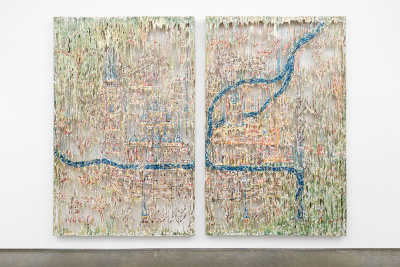
For the past 100 years, artists have increasingly explored unconventional materials and invented new art-making techniques. This exhibition challenged visitors to pay close attention to how artists have manipulated everything from generic ballpoint pens to unusual found objects like snake bones, inviting the viewer to experience the imaginative artistic transformation of materials through diverse creative acts.
Sonoma-based painter Stuppin creates landscapes that celebrate nature. According to SJMA’s Oshman Executive Director Susan Krane, “Stuppin’s landscapes are amplified, as if quick glimpses that he has forever exalted and memorialized. The scenes he offers the viewer are held taut, orderly patterned and captured in brilliant Technicolor. They may remind us of the modernist masters of metaphorical landscapes (from Grant Wood to Marsden Hartley to Arthur Dove), and of images that are part and parcel of Americana.”
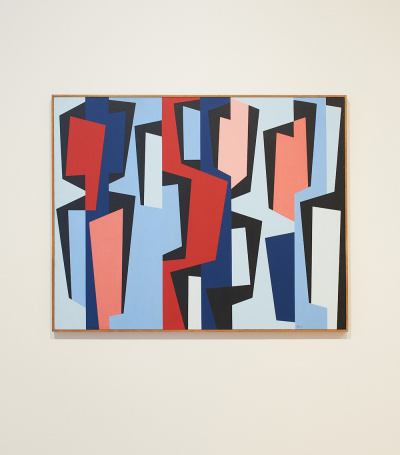
From the mid-1940s to the early 1960s, San Francisco provided the setting for an important group of abstract expressionist painters. This faction is often considered a second-generation spin-off from the New York “action painters” like Jackson Pollock and Willem de Kooning, who worked in gestures and drips. Yet this assumption ignores the powerful culture of spontaneity that permeated the arts on both coasts in the years surrounding the Second World War. This exhibition brought together the work in the Museum’s collection of artists only now being recognized as pioneers of this movement, including Elmer Bischoff, Ernest Briggs, Edward Corbett, Edward Dugmore, James Kelly, Frank Lobdell, Deborah Remington, John Saccaro, and Hassel Smith.
Bronze, marble, stainless steel . . . cardboard? In fact, many of the most highly esteemed artists, like Robert Rauschenberg, Frank Gehry, Joan Brown, and Manuel Neri, have experimented with cardboard as an artistic material. Both relatively inexpensive and ubiquitous, cardboard affords artists the ability to work on a large-scale that might not be otherwise possible. This exhibition revealed ways that artists challenge the limits of cardboard by investigating topics ranging from formal concerns to social commentary and engineering.
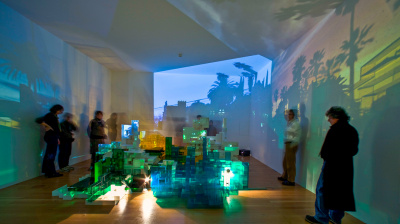
A collaboration between artist Adam Silverman and MIT Architecture Professor Nader Tehrani, Boolean Valley (2008) is a room-sized installation comprising 400 clay objects glazed in a colorful compound of cobalt blue and black, each with silicon carbide added. Together they form a sloping, sculptural landscape derived from the principle of “Boolean logic,” which calibrates the geometry of intersecting objects. Cast from a single mold, each clay vessel is intersected with a variable cut, sliced in two and redistributed over the floor to produce the topography of the landscape.
This exhibition focused on a selection of collages from Satty’s most ambitious series, Visions of Frisco, which interpret San Francisco Gold Rush history from 1848 to the 1890s.
Imagine one hundred lifesize monkeys made out of cardboard dangling from each other and swinging from trapezes. This is what Grashow did to transform the SJMA lobby with his whimsical and lively site-specific installation, creating a visual cacophony just above the viewers’ heads.
Shedding light on the life and art of Kahlo (1907–54), this exhibition featured approximately 50 photographic portraits of the legendary Mexican artist. Drawn from the collection of Spencer Throckmorton, a specialist in Latin American photography, the exhibition included works by renowned photographers as well as Kahlo’s close friends and family.